PV models
The same model options apply to all entry points: gsee.pv.run_model() (single site), gsee.api.run_sites()/run_grid() (many sites), and gsee.climate.run_climate().
Panel technologies
The technology parameter selects the panel model:
technology |
Model | Description |
|---|---|---|
csi (default) |
Huld | Crystalline silicon, coefficients from Huld et al. (2010) |
csi-new (recommended) |
Huld | Crystalline silicon with a revised parametrisation (doi:10.1002/pip.3926), as referenced in pvlib's Huld model |
cis |
Huld | CIS/CIGS thin film, coefficients from Huld et al. (2010) |
cdte |
Huld | CdTe thin film, coefficients from Huld et al. (2010) |
cec-csi-median |
Single-diode | The median mono-c-Si module from the CEC database |
singlediode |
Single-diode | Custom module: requires module_params |
Which crystalline silicon model?
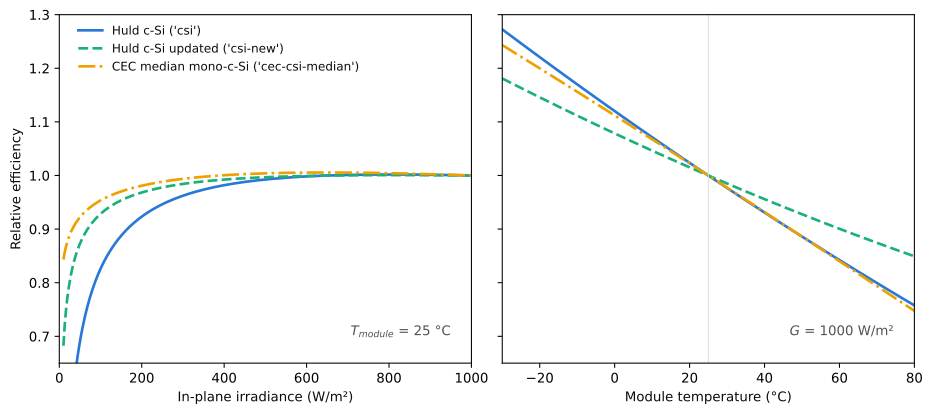
The default csi is kept for continuity with earlier GSEE versions and Renewables.ninja simulations. For modern installations we recommend csi-new: its coefficients are fitted to recent module data and track the physics-based single-diode model much more closely, particularly at low irradiance (see the comparison below). It may become the default in a future version.
The Huld model
The empirical model of Huld et al. (2010) computes the panel's relative efficiency as a function of in-plane irradiance and module temperature, where module temperature is estimated from ambient temperature and irradiance:
c_temp_amb(default 1 °C/°C): module temperature coefficient of ambient temperature.c_temp_irrad(default 0.035 °C/(W/m²)): module temperature coefficient of irradiance. The default value is appropriate for free-standing modules. Use 0.05 for building-integrated modules
This module temperature estimate assumes no wind: at full sun it heats the module 35 °C above ambient, closely matching pvlib's SAPM open-rack model at 0 m/s wind speed. The single-diode path below instead uses SAPM at a 5 m/s reference wind speed.
The single-diode model
The single-diode path uses pvlib's De Soto parameter and single-diode calculations. With technology="singlediode", you must pass module_params, a dict with the CEC database parameters alpha_sc, a_ref, I_L_ref, I_o_ref, R_sh_ref and R_s.
Module temperature is estimated with the SAPM cell temperature model; temperature_params accepts one of the SAPM mounting presets ("open_rack_glass_glass" by default, "close_mount_glass_glass", "open_rack_glass_polymer", "insulated_back_glass_polymer") or a dict with a, b and deltaT.
Comparing the panel models
The figure below compares the relative efficiency of the three crystalline silicon panel models against in-plane irradiance (left, at STC module temperature) and against module temperature (right, at STC irradiance). Both panels vary module temperature directly, so the comparison shows only the efficiency models, not the models' different ambient-to-module temperature estimates. The code to reproduce it is in docs/figures/plot_model_comparison.py (pixi run docs-figures).
Tracking
tracking=0: fixed panels at the giventiltandazim.tracking=1: 1-axis tracking.tiltgives the tilt of the tracking axis relative to horizontal (0 = horizontal axis) andazimthe orientation of the axis.tracking=2: 2-axis tracking. The panel always faces the sun directly (tiltandazimare ignored).
gsee.pv.optimal_tilt(lat) provides a simple latitude-dependent tilt estimate that can be used directly, or passed as a callable to the multi-site and climate entry points.
Plane-of-array irradiance
Global horizontal irradiance is split into its direct and diffuse components via diffuse_fraction and transposed onto the panel plane with an isotropic diffuse model, including ground reflection controlled by albedo (default 0.3).
Inverter and system losses
DC output is clipped to capacity, then converted to AC with the inverter model from PVWatts v5 (Dobos 2014), whose efficiency varies with load:
inverter_capacity(default: equal tocapacity): AC inverter capacity in W. Set this lower thancapacityfor a DC/AC ratio above 1.use_inverter=False: skip the inverter model entirely (returns DC output).
Finally, system_loss (default 0.10) is subtracted as a flat fraction covering all losses not caused by panel and inverter.
References
- Huld, T. et al., 2010: Mapping the performance of PV modules, effects of module type and data averaging. Solar Energy, 84(2), 324-338. doi:10.1016/j.solener.2009.12.002
- Dobos, A. P., 2014: PVWatts Version 5 Manual. NREL Technical Report. nrel.gov/docs/fy14osti/62641.pdf
- Revised Huld c-Si parametrisation ('csi-new'): doi:10.1002/pip.3926